
Article: Ballpoint vs Fountain Pen: Which Should You Choose?
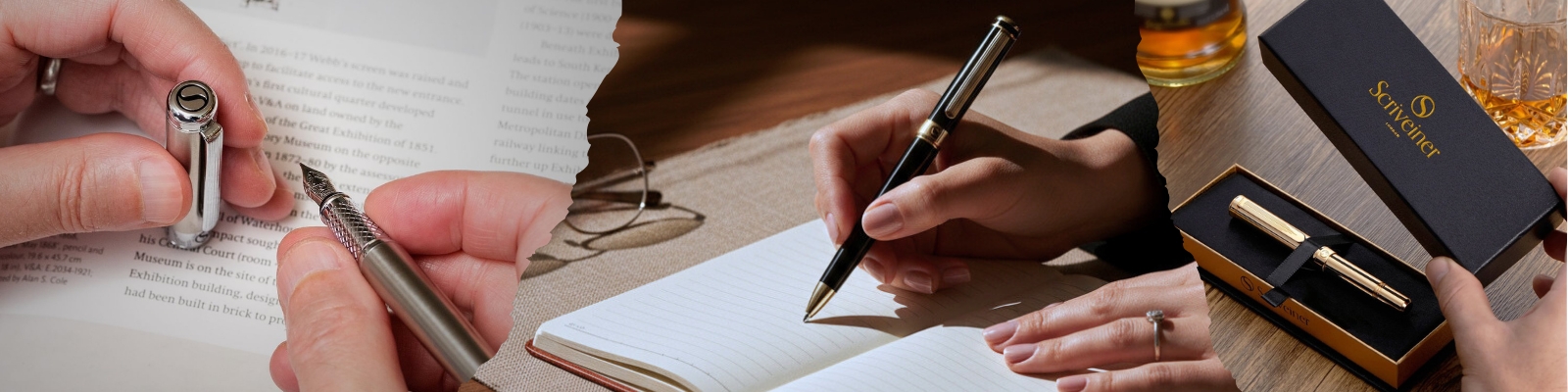
Ballpoint vs Fountain Pen: Which Should You Choose?
The question seems simple. Two pens, one choice. But anyone who has stood in front of a pen display, or found themselves unexpectedly attached to a particular writing instrument, knows that the answer depends entirely on what you actually need from a pen.
This guide covers both types honestly: how each works, where each excels, and where each falls short. If you are buying for yourself, you will find a clear framework for deciding. If you are buying as a gift, you will find the right questions to ask before you do.
How each pen works
Understanding the mechanism helps. The two pens deliver ink in fundamentally different ways, and those differences shape everything — the feel, the maintenance, the writing experience.
The ballpoint pen uses oil-based ink stored in a sealed cartridge. A small metal ball at the tip rotates as it moves across paper, picking up ink from the cartridge and depositing it on the page. The ink is thick and fast-drying, which makes ballpoints reliable across almost any surface and in almost any condition. There is very little that can go wrong with one.
The fountain pen uses water-based ink drawn from a cartridge, converter, or built-in reservoir. Ink travels through a feed system to the nib — a split metal tip that maintains a continuous flow through capillary action. The ink is thinner, the line is wetter, and the experience of writing is noticeably different: the nib glides rather than rolls, and the pen responds to the angle and pressure of the hand.
Where they differ: a direct comparison
|
Ballpoint |
Fountain pen |
|
|
Ink type |
Oil-based |
Water-based |
|
Ink delivery |
Rolling ball |
Split nib, capillary flow |
|
Writing feel |
Firm, consistent |
Smooth, responsive |
|
Pressure required |
Moderate |
Minimal |
|
Drying time |
Immediate |
A few seconds |
|
Paper sensitivity |
Works on almost anything |
Performs best on quality paper |
|
Maintenance |
None |
Occasional cleaning |
|
Ink colours available |
Limited |
Extensive |
|
Lifespan |
Disposable or refillable |
Indefinite with care |
|
Running cost |
Low to moderate |
Low (refills are economical) |
|
Best for |
Everyday use, forms, crafts, travel |
Extended writing, correspondence, personal use |
|
Handwriting size |
Suits larger handwriting — line is naturally broader |
Fine and extra-fine nibs suit smaller, more precise handwriting |
The case for ballpoint
Ballpoints are the most practical writing instrument available. They work reliably on glossy paper, receipts, carbon forms, and notebooks alike. They do not require warming up, do not skip if held at an unusual angle, and do not leak in the pressure changes of air travel. For most day-to-day writing — notes, signatures, quick correspondence — they do the job without asking anything of the writer in return.
A quality ballpoint is also considerably more forgiving. There is no nib to align, no ink flow to adjust, no paper to select. You uncap it and write. For someone who needs a pen to simply work, every time, without thought, the ballpoint delivers.
The writing experience is firm and consistent. Some writers prefer this — the slight resistance of the ball against the page gives a sense of control that the smoother fountain pen does not always provide.
Where ballpoints fall short is in expressive range. The line is largely uniform regardless of how you hold the pen or how you move it. For writers who want the instrument to respond to their hand — to vary, to flex, to feel alive on the page — the ballpoint reaches its limits relatively quickly.
The case for fountain pen
A fountain pen asks more of its owner and gives more in return. The writing experience is the primary argument: the nib moves across paper with a smoothness that a ballpoint cannot replicate, and over time, a fountain pen nib subtly adapts to the angle and pressure of the individual hand. It becomes, in a real sense, yours.
The expressive range is wider. Nib widths vary from fine to broad, flex nibs respond to pressure with line variation, and the water-based inks available span hundreds of colours and formulations. For anyone who writes at length — journals, letters, manuscripts — the reduced hand fatigue alone makes a compelling case. You do not press a fountain pen; you guide it.
Fountain pens are also significantly better for the environment and, over time, more economical. A quality pen purchased once, cared for, and refilled indefinitely represents far less waste than a succession of disposable ballpoints.
The demands are real, however. Fountain pens perform best on paper with some tooth and weight — cheap paper feathers and bleeds. They require cleaning every few weeks if in regular use. They should be stored with the nib up or horizontal. None of this is onerous, but it is a different relationship with a writing instrument than most people are accustomed to.
Which should you choose?
Choose a ballpoint if:
-
You need a pen that works reliably across all paper types and conditions
-
You write in short bursts — notes, signatures, quick tasks — rather than at length
-
You travel frequently and need a pen that won't leak
-
You want zero maintenance
-
You are buying a pen as a practical gift for someone with no particular interest in writing instruments
Choose a fountain pen if:
-
You write regularly and at length — journaling, correspondence, longhand drafting
-
You want an instrument that improves with use and feels personal
-
You care about the physical experience of writing, not just the output
-
You are interested in ink as a medium — colour, character, variety
-
You are buying a gift for someone who will notice the difference
If you are still undecided:
Consider how you hold a pen. If you write with heavy pressure, a ballpoint is likely more comfortable. If you hold a pen lightly and move it freely, a fountain pen will reward that instinct immediately.
Consider also the context. A pen kept in a jacket pocket for occasional use is a different object from a pen that lives on a desk and accompanies an hour of writing each morning. The ballpoint excels in the first role; the fountain pen in the second.
A note on quality
The comparison above assumes pens of comparable quality. A cheap fountain pen is not representative of what a fountain pen can be — the nib scratches, the ink skips, the experience discourages rather than invites. The same is true of a cheap ballpoint: the ink is watery, the ball drags, the pen is forgotten in a drawer.
At the quality end of both categories, the writing experience improves considerably. The ballpoint becomes precise and satisfying. The fountain pen becomes something genuinely pleasurable. The choice between them is then a matter of preference and purpose rather than performance.
Scriveiner makes both. If you are unsure where to begin, the Pen-Finding Tool takes two minutes and removes the guesswork.
Caring for your pen
Ballpoint: No routine maintenance required. If the ink stops flowing, warm the tip gently or replace the refill. Store horizontally or tip-down.
Fountain pen: Rinse with cool water every three to four weeks, or whenever changing ink colours. Store horizontally or nib-up. Avoid leaving unfilled for extended periods, which can dry the feed. A well-maintained fountain pen will outlast any ballpoint made.

Leave a comment
This site is protected by hCaptcha and the hCaptcha Privacy Policy and Terms of Service apply.